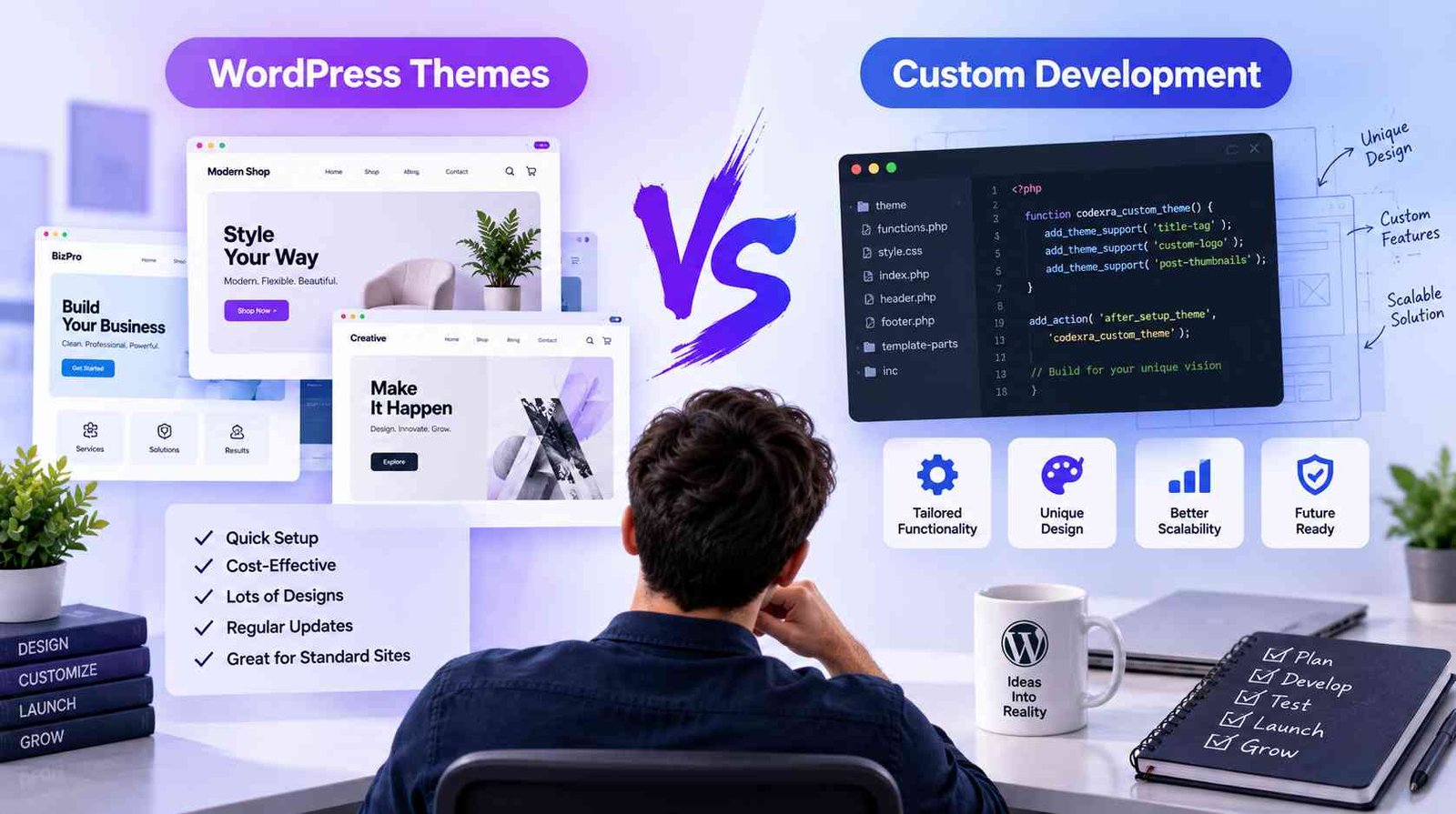
One Platform, Different Ways to Build
Starting a new WordPress website usually leads to an important decision:
Should you use an existing theme or develop something custom?
There is no universal answer.
Both approaches can produce excellent websites when they are selected for the right reasons and implemented properly.
The better decision depends on your budget, timeline, requirements, design expectations, technical complexity, and long-term plans.
What Is a WordPress Theme?
WordPress defines a theme as a collection of files that work together to control the graphical interface and unified design of a website. Themes can influence both the presentation of content and how certain visual elements behave.
Traditionally, WordPress themes relied heavily on PHP templates, stylesheets, and the Customizer.
Modern block themes take a different approach.
A block theme uses blocks throughout the website—including headers, navigation, content areas, and footers—and works with the WordPress Site Editor.
This gives website owners much more visual control without necessarily modifying template code.
When a Ready-Made Theme Makes Sense
Themes are an efficient option when your website requirements fit a relatively standard structure.
A business website may need a homepage, services, About page, blog, contact form, and several landing pages. A quality theme can provide a strong starting point.
Themes can also reduce initial development time because common layout systems and design components have already been created.
For smaller projects, this may allow more of the budget to be spent on content, branding, SEO, photography, or marketing instead of rebuilding standard functionality.
The WordPress.org Theme Directory contains thousands of themes, and themes submitted there are reviewed against directory requirements.
However, you should still evaluate any theme according to your own requirements.
The Limitations of Using a Theme
Problems usually begin when a theme is forced to do something it was never designed to do.
Heavy customization may require custom CSS, template overrides, child themes, plugins, code snippets, and workarounds.
Eventually, a project that started as a simple theme customization can become more complex than a purpose-built solution.
Multipurpose themes may also include functionality your website never uses.
This does not automatically make them bad. It simply means that choosing a theme should be based on your actual needs rather than the appearance of its demo.
What Does Custom WordPress Development Mean?
Custom development means creating functionality, templates, components, integrations, or other website behavior specifically for a project’s requirements.
It does not necessarily mean rebuilding WordPress itself.
WordPress core should remain untouched. The official Plugin Developer Handbook specifically advises developers not to modify core files and recommends extending functionality through plugins instead.
A custom project might therefore combine WordPress core with a custom theme, custom plugin, third-party services, and selected existing plugins.
The goal is not to reinvent every component. It is to customize the parts where a business gains meaningful value from doing so.
Comparing Design Flexibility
A well-designed theme offers considerable flexibility, particularly with modern block themes.
WordPress’s Site Editor can provide control over templates, template parts, typography, colors, layouts, headers, footers, and other global elements.
For many websites, that is more than enough.
Custom development becomes attractive when the required interface is highly specialized or when the website must follow a very specific design system that does not naturally fit an existing theme.
The question is therefore not “Which approach gives more control?”
Custom development will generally provide greater control.
The more important question is whether your project actually needs that level of control.
Comparing Cost
A theme-based website normally has a lower initial development cost because much of the foundational work has already been completed.
Custom development requires more planning, design, coding, testing, and quality assurance.
However, initial price does not tell the entire story.
If a low-cost theme requires extensive modifications, numerous paid extensions, repeated fixes, and compromises to important workflows, its long-term cost may increase.
Likewise, paying for custom development when your needs could easily be met by an existing theme may be unnecessary.
Evaluate total value rather than simply comparing initial prices.
Comparing Performance
Neither approach is automatically faster.
A lightweight existing theme can perform exceptionally well.
A badly developed custom theme can perform poorly.
Likewise, a carefully engineered custom system can avoid unnecessary functionality and be optimized around a specific website.
Performance depends on implementation.
Hosting, plugins, images, scripts, fonts, caching, databases, third-party services, and development quality all contribute to the final result.
This is why performance should be measured rather than assumed.
Comparing Scalability
Think about what the website will need in two or three years—not only what it needs today.
Will you introduce memberships? Multiple languages? Complex WooCommerce workflows? Customer dashboards? Integrations with external software? Custom product configuration? Large content libraries?
If future functionality is predictable, planning for it early can avoid expensive restructuring.
Themes work extremely well when future needs remain within their intended architecture.
Custom development becomes more valuable when the website itself is becoming part of a specialized business system.
Comparing Maintenance
Every WordPress website requires maintenance.
WordPress core, themes, and plugins receive updates. Hosting environments evolve. PHP versions change. Security issues emerge. Browser technologies develop.
A widely used theme may benefit from an established development team and broader user community.
Custom development gives you more control but also means responsibility for maintaining the custom code.
The right development partner should therefore create documentation and maintainable code rather than building a system only one developer understands.
Long-term maintainability should be considered during development, not after launch.
A Hybrid Approach Is Often Best
The choice does not always have to be completely “theme” or completely “custom.”
Many strong WordPress websites use a hybrid approach.
A quality theme or block theme may provide the design foundation, while custom plugins handle specialized business functionality.
Alternatively, a custom theme might rely on carefully selected existing plugins for common features such as forms or SEO.
This prevents unnecessary reinvention while still allowing important parts of the website to be purpose-built.
How to Make the Right Decision
Start with requirements rather than technology.
Define what the website must accomplish, who will manage it, what users need to do, which integrations are necessary, what your budget allows, and how the site is expected to evolve.
Then choose the simplest architecture that can support those requirements properly.
For a straightforward company website, a quality theme may be ideal.
For a highly specialized platform with unique workflows, custom development may provide better long-term value.
For many projects, combining the two approaches delivers the best balance.
Final Thoughts
WordPress themes and custom development are not competing philosophies.
They are tools for different situations.
The right theme can help you launch quickly with a professional, manageable website. Custom development can provide greater control when your business requires functionality that standard solutions cannot provide effectively.
What matters most is building around your real requirements instead of forcing your requirements around the technology.
At Codexra, we believe good WordPress development starts with understanding the problem first—and choosing the right solution second.